Overview
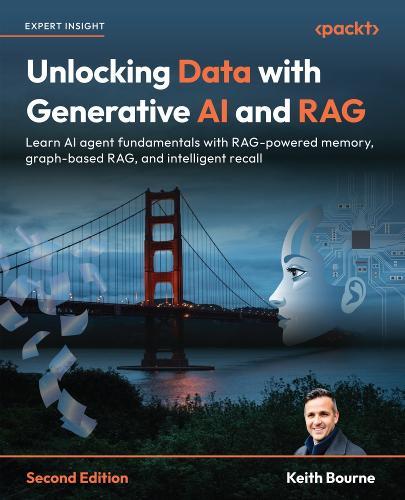
Design intelligent AI agents with retrieval-augmented generation, memory components, and graph-based context integration Free with your book: DRM-free PDF version + access to Packt's next-gen Reader* Key Features Build next-gen AI systems using agent memory, semantic caches, and LangMem Implement graph-based retrieval pipelines with ontologies and vector search Create intelligent, self-improving AI agents with agentic memory architectures Book DescriptionDeveloping AI agents that remember, adapt, and reason over complex knowledge isn’t a distant vision anymore; it’s happening now with Retrieval-Augmented Generation (RAG). This second edition of the bestselling guide leads you to the forefront of agentic system design, showing you how to build intelligent, explainable, and context-aware applications powered by RAG pipelines. You’ll master the building blocks of agentic memory, including semantic caches, procedural learning with LangMem, and the emerging CoALA framework for cognitive agents. You’ll also learn how to integrate GraphRAG with tools such as Neo4j to create deeply contextualized AI responses grounded in ontology-driven data. This book walks you through real implementations of working, episodic, semantic, and procedural memory using vector stores, prompting strategies, and feedback loops to create systems that continuously learn and refine their behavior. With hands-on code and production-ready patterns, you’ll be ready to build advanced AI systems that not only generate answers but also learn, recall, and evolve. Written by a seasoned AI educator and engineer, this book blends conceptual clarity with practical insight, offering both foundational knowledge and cutting-edge tools for modern AI development. *Email sign-up and proof of purchase required What you will learn Architect graph-powered RAG agents with ontology-driven knowledge bases Build semantic caches to improve response speed and reduce hallucinations Code memory pipelines for working, episodic, semantic, and procedural recall Implement agentic learning using LangMem and prompt optimization strategies Integrate retrieval, generation, and consolidation for self-improving agents Design caching and memory schemas for scalable, adaptive AI systems Use Neo4j, LangChain, and vector databases in production-ready RAG pipelines Who this book is forIf you’re an AI engineer, data scientist, or developer building agent-based AI systems, this book will guide you with its deep coverage of retrieval-augmented generation, memory components, and intelligent prompting. With a basic understanding of Python and LLMs, you’ll be able to make the most of what this book offers.
Full Product Details
Author: Keith Bourne
Publisher: Packt Publishing Limited
Imprint: Packt Publishing Limited
Edition: 2nd Revised edition
ISBN: 9781806381654
ISBN 10: 1806381656
Pages: 606
Publication Date: 30 December 2025
Audience:
General/trade
,
General
Format: Paperback
Publisher's Status: Active
Availability: In Print

This item will be ordered in for you from one of our suppliers. Upon receipt, we will promptly dispatch it out to you. For in store availability, please contact us.
Author Information
Keith Bourne is an agent engineer at Magnifi by TIFIN, founder of Memriq AI, and producer of The Memriq AI Inference Brief. With over a decade of experience building production ML and AI systems across start-ups and Fortune 50 enterprises, Keith holds an MBA from Babson College and a master's in applied data science from the University of Michigan. He has built sophisticated generative AI platforms using advanced RAG techniques, agentic architectures, and model fine-tuning.