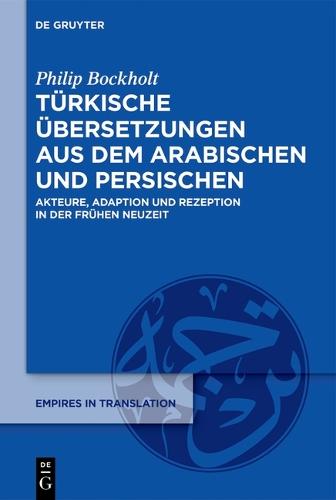
Overview
This series presents the findings of the Emmy Noether Junior Research Group TRANSLAPT (Translation: Arabic-Persian-Turkish) which examines the central role of translation in the formation of the Ottoman Empire during the early modern period (c. 1400-1750). Against the backdrop of confessional and political polarisation in the Eastern Mediterranean and the Middle East, an increasing number of works were received, translated, and commented on across linguistic, cultural, and sectarian boundaries at this time. Using a multidisciplinary approach that brings together Middle Eastern studies, translation studies, and material philology, the series explores the transregional transfer of knowledge throughout the Islamic world. However, rather than treating translation as mere linguistic transfer, by considering it as a concept, a process, and a product, the project moves beyond reductionist models to develop a historically grounded account of the cultural functions of translation, in particular, its role in ideological self-positioning and confessional demarcation. Without attention to these dynamics, the region's intellectual history remains only partially understood. The series investigates which actors were involved in translation, which concepts and terms (e.g., tarjama, terceme, tercüme) were employed, how translations relate to their source texts, and how they were visually and materially represented. These inquiries illuminate the sociocultural, geographical, and political conditions under which translations were produced and circulated, and reveal regional aesthetic conventions and literary practices. The series is comprised of several monographs and conference proceedings on translations across a range of genres and contexts, from within and beyond the Ottoman Empire, including (mystical) advice literature, historiography, biography, encyclopaedia, hadith, Qurʾanic exegesis, Turkish literature in Mamluk Egypt, and translation practices in early-modern Central Asia. In doing so, the series closes significant gaps in current scholarship and prompts scholars to reconsider the role of translation as a driver of cultural and intellectual transformation in the early modern Islamic world. Addressing a multidisciplinary audience, it presents texts in Arabic, Persian, and Turkic alongside new, in-depth studies for the wider English-speaking scholarly public.
Full Product Details
Author: Philip Bockholt
Publisher: De Gruyter
Imprint: De Gruyter
Weight: 0.500kg
ISBN: 9783119143790
ISBN 10: 3119143790
Pages: 418
Publication Date: 16 February 2026
Audience:
General/trade
,
General
Format: Hardback
Publisher's Status: Forthcoming
Availability: Not yet available

This item is yet to be released. You can pre-order this item and we will dispatch it to you upon its release.
Language: German
Author Information
Philip Bockholt, Universität Münster.