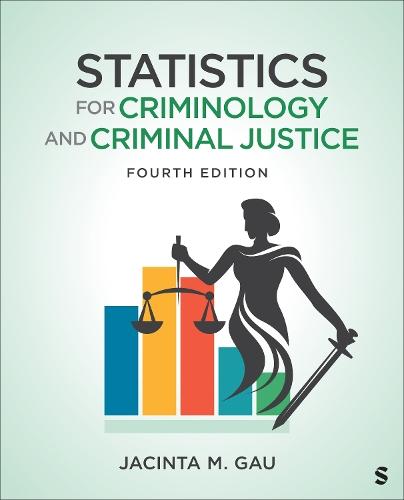
Statistics for Criminology and Criminal Justice

Author:   Jacinta M. Gau
Publisher:   SAGE Publications Inc
Edition:   4th Revised edition
ISBN:  

9781071816653


Pages:   512
Publication Date:   05 December 2025
Format:   Paperback
Availability:   In Print   Availability explained
This item will be ordered in for you from one of our suppliers. Upon receipt, we will promptly dispatch it out to you. For in store availability, please contact us.

Our Price $359.66 Quantity:  
Add to Cart

Share |

Statistics for Criminology and Criminal Justice


Overview

Full Product Details

Author:   Jacinta M. Gau
Publisher:   SAGE Publications Inc
Imprint:   SAGE Publications Inc
Edition:   4th Revised edition
Weight:   0.910kg
ISBN:  

9781071816653


ISBN 10:   1071816659
Pages:   512
Publication Date:   05 December 2025
Audience:   College/higher education ,  Tertiary & Higher Education
Format:   Paperback
Publisher's Status:   Active
Availability:   In Print   Availability explained
This item will be ordered in for you from one of our suppliers. Upon receipt, we will promptly dispatch it out to you. For in store availability, please contact us.

Table of Contents

Preface to the Third Edition Acknowledgments About the Author Part I: Descriptive Statistics Chapter 1: Introduction to the Use of Statistics in Criminal Justice and Criminology Science: Basic Terms and Concepts Types of Scientific Research in Criminal Justice and Criminology Software Packages for Statistical Analysis Organization of the Book Thinking Critically Review Problems Key Terms Chapter 2: Types of Variables and Levels of Measurement Units and Levels of Analysis Independent Variables and Dependent Variables Correlation versus Causation Levels of Measurement Chapter Summary Thinking Critically Review Problems Key Terms Chapter 3: Organizing, Displaying, and Presenting Data Data Distributions Graphs and Charts Grouping Data SPSS Chapter Summary Thinking Critically Review Problems Key Terms Glossary of Symbols and Abbreviations Introduced in This Chapter Chapter 4: Measures of Central Tendency Distribution Shapes The Median The Mean Using Means and Medians to Determine Distribution Shape Deviation Scores and the Mean as the Midpoint of the Magnitudes SPSS Chapter Summary Thinking Critically Review Problems Key Terms Glossary of Symbols and Abbreviations Introduced in This Chapter Chapter 5: Measures of Dispersion The Variation Ratio The Range The Variance The Standard Deviation The Standard Deviation and the Normal Curve Chapter Summary Thinking Critically Review Problems Key Terms Glossary of Symbols and Abbreviations Introduced in This Chapter Part II: Probability and Distributions Chapter 6: Probability Discrete Probability: The Binomial Probability Distribution Continuous Probability: The Standard Normal Curve Chapter Summary Thinking Critically Review Problems Key Terms Glossary of Symbols and Abbreviations Introduced in This Chapter Chapter 7: Population, Sample, and Sampling Distributions Empirical Distributions: Population and Sample Distributions Theoretical Distributions: Sampling Distributions Sample Size and the Sampling Distribution: The z and t Distributions Chapter Summary Thinking Critically Review Problems Key Terms Glossary of Symbols and Abbreviations Introduced in This Chapter Chapter 8: Point Estimates and Confidence Intervals The Level of Confidence: The Probability of Being Correct Confidence Intervals for Means with Large Samples Confidence Intervals for Means with Small Samples Confidence Intervals with Proportions Chapter Summary Thinking Critically Review Problems Key Terms Glossary of Symbols and Abbreviations Introduced in This Chapter Part III: Hypothesis Testing Chapter 9: Hypothesis Testing: A Conceptual Introduction Sample Statistics and Population Parameters: Sampling Error or True Difference? Null and Alternative Hypotheses Chapter Summary Thinking Critically Review Problems Key Terms Glossary of Symbols and Abbreviations Introduced in This Chapter Chapter 10: Hypothesis Testing with Two Categorical Variables: Chi-Square The Chi-Square Test of Independence Measures of Association SPSS Chapter Summary Thinking Critically Review Problems Key Terms Glossary of Symbols and Abbreviations Introduced in This Chapter Chapter 11: Hypothesis Testing with Two Population Means or Proportions Two-Population Tests for Differences Between Means: t Tests Two-Population Tests for Differences Between Proportions SPSS Chapter Summary Thinking Critically Review Problems Key Terms Glossary of Symbols and Abbreviations Introduced in This Chapter Chapter 12: Hypothesis Testing with Three or More Population Means: Analysis of Variance ANOVA: Different Types of Variances When the Null Is Rejected: A Measure of Association and Post Hoc Tests SPSS Chapter Summary Thinking Critically Review Problems Key Terms Glossary of Symbols and Abbreviations Introduced in This Chapter Chapter 13: Hypothesis Testing with Two Continuous Variables: Correlation Beyond Statistical Significance: Sign, Magnitude, and Coefficient of Determination SPSS Chapter Summary Thinking Critically Review Problems Key Terms Glossary of Symbols and Abbreviations Introduced in This Chapter Chapter 14: Introduction to Regression Analysis One Independent Variable and One Dependent Variable: Bivariate Regression Adding Independent Variables: Multiple Regression Alternatives to Ordinary Least Squares Regression Ordinary Least Squares and Logistic Regression in SPSS Chapter Summary Thinking Critically Review Problems Key Terms Glossary of Symbols and Abbreviations Introduced in This Chapter Appendix A. Review of Basic Mathematical Techniques Appendix B. Standard Normal (z) Distribution Appendix C. t Distribution Appendix D. Chi-Square (?2) Distribution Appendix E. F Distribution Glossary Learning Checks Answer Key Review Problems Answer Key References Index

Reviews

Author Information

Jacinta M. Gau, Ph.D., is an associate professor in the Department of Criminal Justice at the University of Central Florida. She received her doctorate from Washington State University in 2008. Her primary areas of research are policing and criminal justice policy, and she has a strong quantitative background. Dr. Gau’s work has appeared in journals such as Justice Quarterly, British Journal of Criminology, Criminal Justice and Behavior, Crime & Delinquency, Criminology & Public Policy, Police Quarterly, Policing: An International Journal of Police Strategies & Management, and the Journal of Criminal Justice Education. In addition to Statistics for Criminology and Criminal Justice, she is author of Criminal Justice Policy: Origins and Effectiveness (Oxford University Press) and co-author of Key Ideas in Criminology and Criminal Justice (SAGE Publications). Additionally, she co-edits Race and Justice: An International Journal, published by SAGE.  

Tab Content 6

Author Website:  

Countries Available

All regions
Latest Reading Guide

NOV RG 20252


Shopping Cart
Your cart is empty
Shopping cart
Mailing List