Overview
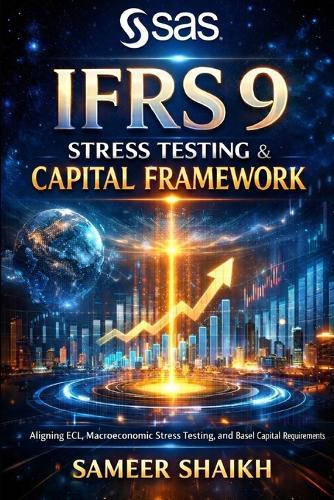
Stress testing has evolved from a periodic regulatory exercise into a core decision-making tool for banks, regulators, and risk professionals. What was once treated as a standalone compliance activity is now expected to be fully integrated with IFRS 9 expected credit loss, capital adequacy, and management actions. Yet in practice, many institutions still struggle to explain one consistent story. The same portfolio produces different numbers for: IFRS 9 impairment Stress testing losses Capital and risk-weighted assets These differences are often not wrong - but they are poorly connected, weakly governed, and difficult to explain under regulatory scrutiny. This book addresses that gap. Why This Book Was WrittenRegulators today do not ask only what the numbers are. They ask: Why do these numbers change under stress? How does stress flow through staging, ECL, and capital? Can the results be reproduced? Can management actions be justified? Can the logic be traced back to loan-level data? Answering these questions requires more than formulas. It requires a structured, auditable, and executable framework. This book presents such a framework using SAS as the execution engine. What Makes Stress Testing DifferentStress testing is not just about applying shocks. It is about understanding: How macroeconomic deterioration affects credit risk parameters How stage migration amplifies losses How forward-looking overlays change lifetime expectations How stressed losses translate into capital impact When stress testing is isolated from IFRS 9 and capital, it creates confusion rather than insight. Integration turns stress testing into a powerful narrative tool. Why SAS Is Central to This FrameworkSAS remains the dominant platform in regulated banking environments for a reason: Deterministic processing Transparent data handling Strong governance and auditability Proven scalability This book does not treat SAS as a coding language. It treats SAS as an evidence platform - one that can support regulatory reviews, internal audits, and board-level discussions. All examples in this book are implemented using clear, reproducible SAS logic, designed to be explained line-by-line. Who This Book Is ForThis book is written for: Risk professionals working on stress testing and IFRS 9 Capital and ICAAP teams Model validation and audit teams Regulators and supervisory reviewers SAS practitioners supporting risk and finance functions It assumes familiarity with basic credit risk concepts but does not assume prior stress testing expertise.
Full Product Details
Author: Sameer Shaikh
Publisher: Independently Published
Imprint: Independently Published
Dimensions:
Width: 15.20cm
, Height: 1.50cm
, Length: 22.90cm
Weight: 0.345kg
ISBN: 9798242159471
Pages: 256
Publication Date: 01 January 2026
Audience:
General/trade
,
General
Format: Paperback
Publisher's Status: Active
Availability: Available To Order

We have confirmation that this item is in stock with the supplier. It will be ordered in for you and dispatched immediately.