Overview
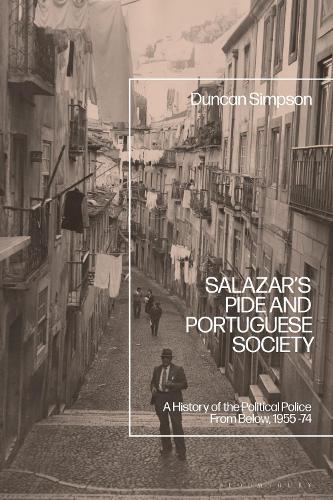
This book reconceptualizes the relationship between Portuguese society and Salazar’s political police. By studying the PIDE from below, Salazar’s PIDE and Portuguese Society challenges the prevailing historiographic emphasis on processes of top-down repression whose effect has been to relegate the bulk of the population to the status of passive victims. The analysis concentrates on various forms of spontaneous interactions between individual citizens and the PIDE. Duncan Simpson focuses on the mass of depoliticised citizens, rather than the small minority of oppositionists, using new research methodologies, like oral history and opinion surveying, and original archival material in the form of denunciation letters, petitions, and applications to join the PIDE. From a theoretical perspective, the book draws on the international scholarship of totalitarianism, ‘accusatory practices’, and everyday life under dictatorship; work which has highlighted the complexity of the relations between State and society by uncovering the prevalence of widespread processes of individual adjustment and accommodation. Indeed Simpson’s underlying – and convincing – argument is that the relationship between the PIDE and society was far more dynamic, multifaceted, and interactive than has been acknowledged until now.
Full Product Details
Author: Dr Duncan Simpson (University of Lisbon, Portugal)
Publisher: Bloomsbury Publishing PLC
Imprint: Bloomsbury Academic
Dimensions:
Width: 16.40cm
, Height: 1.60cm
, Length: 23.60cm
Weight: 0.440kg
ISBN: 9781350410268
ISBN 10: 1350410268
Pages: 192
Publication Date: 22 January 2026
Audience:
Professional and scholarly
,
Professional & Vocational
Format: Hardback
Publisher's Status: Active
Availability: Manufactured on demand

We will order this item for you from a manufactured on demand supplier.
Reviews
Thanks to this excellent bottom-up study of the Portuguese PIDE, we can better understand how neither the political police forces of dictatorships are as distant and distinct from the societies they monitor and repress as we think, nor are societies as innocent or terrified as we sometimes like to believe. * Antonio Cazorla-Sánchez, Professor Department of History, Trent University, Canada * The Portuguese political police under the authoritarian Estado Novo were a force of repression and terror for many – but also a useful resource for many others. In the best tradition of the everyday life history approach, Duncan Simpson impressively demonstrates the complexities of such local realities in postwar Portugal. Salazar’s PIDE and Portuguese Society offers groundbreaking analysis to shed light on those who saw the forces of repression as something normal to live with, or even as something tremendously useful for their own goals. * Alexander Keese, Professor, University of Geneva, Switzerland *
Author Information
Duncan Simpson is Research Fellow at the Institute of Social Sciences of the University of Lisbon, Portugal.