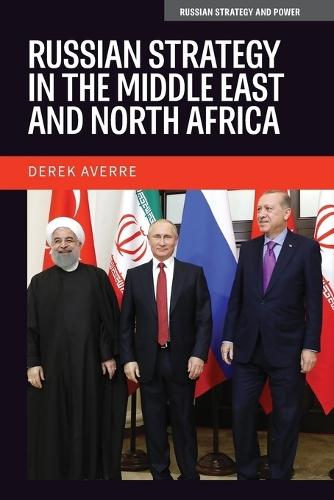
Overview
This book analyses Russia's strategy in the Middle East and North Africa (MENA) in the turbulent period since the inception of the Arab Spring. It explores the key policy challenges faced by Russia in the context of Russia's relations with both the regional states and the major external powers. The book incorporates chapters on Russia's involvement in MENA affairs, its intervention in the Syrian civil war, the domestic sources of its foreign policy, its clash with the Western powers over issues pertaining to sovereignty and humanitarian norms, its response to the challenge posed by Islamist extremism, and its political-military and economic interests in the MENA region. The book offers an original, critical analysis of Russia's thinking and decision-making and examines the implications of its more assertive foreign policy strategy following its military interventions in Syria and Ukraine.
Full Product Details
Author: Derek Averre
Publisher: Manchester University Press
Imprint: Manchester University Press
Dimensions:
Width: 15.60cm
, Height: 1.60cm
, Length: 23.40cm
Weight: 0.414kg
ISBN: 9781526195586
ISBN 10: 1526195585
Pages: 288
Publication Date: 20 January 2026
Audience:
College/higher education
,
Professional and scholarly
,
Tertiary & Higher Education
,
Professional & Vocational
Format: Paperback
Publisher's Status: Active
Availability: Not yet available, will be POD

This item is yet to be released. You can pre-order this item and we will dispatch it to you upon it's release. This is a print on demand item which is still yet to be released.
Reviews
‘Averre's monograph is one of the few books I consider to be essential for understanding the complexity of Russia's relationship with the Middle East.’ —Mark N. Katz, Professor Emeritus, George Mason University ‘Averre’s important work shows how Russia’s complex, multi-faceted strategy in the Middle East and North Africa is often misunderstood by Western commentators. The book is essential reading for “getting Russia right”.' —James Nixey, Former Director, Russia and Eurasia Programme, Chatham House -- .
‘Averre's monograph is one of the few books I consider to be essential for understanding the complexity of Russia's relationship with the Middle East.’ Mark N. Katz, Professor Emeritus, George Mason University ‘Averre’s important work shows how Russia’s complex, multi-faceted strategy in the Middle East and North Africa is often misunderstood by Western commentators. The book is essential reading for “getting Russia right”.' James Nixey, Former Director, Russia and Eurasia Programme, Chatham House 'The importance of understanding Russia’s transformational involvement in the MENA region, which is marked by proxy conflicts, shifting alliances and normative struggles over sovereignty, cannot be overestimated. Derek Averre’s new book offers a persuasive account of the security interests as well as the regional and domestic dynamics that shaped Russia’s MENA policy, from its response to the Arab Spring to its relations with a network of regional, external and non-state actors... As a result, the book offers a comprehensive account of Russian decision-making and a far more layered account than those centred on material capabilities, international norms or authoritarian opportunism alone.' Kalina Zhekova, International Affairs -- .
‘Averre's monograph is one of the few books I consider to be essential for understanding the complexity of Russia's relationship with the Middle East.’ Mark N. Katz, Professor Emeritus, George Mason University ‘Averre’s important work shows how Russia’s complex, multi-faceted strategy in the Middle East and North Africa is often misunderstood by Western commentators. The book is essential reading for “getting Russia right”.' James Nixey, Former Director, Russia and Eurasia Programme, Chatham House 'The importance of understanding Russia’s transformational involvement in the MENA region, which is marked by proxy conflicts, shifting alliances and normative struggles over sovereignty, cannot be overestimated. Derek Averre’s new book offers a persuasive account of the security interests as well as the regional and domestic dynamics that shaped Russia’s MENA policy, from its response to the Arab Spring to its relations with a network of regional, external and non-state actors... As a result, the book offers a comprehensive account of Russian decision-making and a far more layered account than those centred on material capabilities, international norms or authoritarian opportunism alone.' Kalina Zhekova, International Affairs 'The author demonstrates the fragility of often dominant perspectives, such as the view that Russian strategy is solely driven by a desire to restore its international status to Soviet-era levels. Averre shows how such simplistic interpretations fail to capture the broader spectrum of internal and external, structural and contingent, factors that influence and define the Russian approach.' Nicolò Murgia, The International Spectator CHOICE Recommended: Graduate students and faculty. 'Russian Strategy in the Middle East and North Africa is a valuable contribution to the literature on Russia’s foreign policy... Averre (Univ. of Birmingham, England) forgoes analyzing Russian actions through a single foreign policy lens, instead using an eclectic, analytical approach to explain Russian foreign policy in the region since 2011. The study employs four explanatory factors: structural power, the Russian elite's conceptions of international norms, domestic politics, and Vladimir Putin’s agency. The result is a rich and detailed account of the motivations of Russian action... With recent developments in Syria, the book is crucial for understanding how unfolding events may affect Russia’s interests in the region.' --J. R. Clardie, Northwest Nazarene University -- .
Author Information
Derek Averre is Honorary Reader at the University of Birmingham