Overview
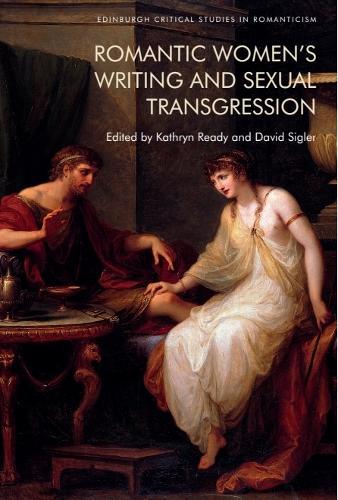
Women's writing was a crucial part of the history of sexuality in the Romantic period, yet has not often been seen as part of that history. This collection shows how women writers fit into a tradition of Romanticism that recognizes transgressive sexuality as a defining feature. Building on recent research on the period's sexual culture, it shows how women writers were theorizing perversions in their literary work and often leading transgressive sexual lives. In doing so, the collection also challenges current understandings of 'transgression' as a sexual category.
Full Product Details
Author: Kathryn Ready (Professor of English, University of Winnipeg) ,
David Sigler (Professor of English, University of Calgary)
Publisher: Edinburgh University Press
Imprint: Edinburgh University Press
ISBN: 9781399507639
ISBN 10: 139950763
Pages: 208
Publication Date: 01 December 2025
Audience:
College/higher education
,
Postgraduate, Research & Scholarly
Format: Paperback
Publisher's Status: Active
Availability: Not yet available

This item is yet to be released. You can pre-order this item and we will dispatch it to you upon its release.
Language: English
Reviews
In this fascinating, thought-provoking anthology, a variety of authors encourage us to “rethink the meaning of transgression” through the lenses of aesthetics, feminist and queer theories, disability studies, and exemplary close readings of women’s writing. [...] Together, all these essays work to interrogate the notion of transgression as it relates to gender. Whether it is through objects, idealized, utopian spaces, self-pleasure, narrative strategies, trans identities, or disruptive normative ideals, these essays invite us to consider not only how female/non-binary writers transgress social norms but, perhaps more importantly, what alternatives they envision. -- Kathleen Béres Rogers College of Charleston * European Romantic Review * Romantic Women’s Writing and Sexual Transgression explores a strikingly understudied subject in a period that has long been defined by its major male poets. This fine collection of essays moves the field forward with its illuminating, provocative chapters on how women’s writing, too, encountered and enacted transgressive sexuality. -- Devoney Looser, Arizona State University
Romantic Women’s Writing and Sexual Transgression explores a strikingly understudied subject in a period that has long been defined by its major male poets. This fine collection of essays moves the field forward with its illuminating, provocative chapters on how women’s writing, too, encountered and enacted transgressive sexuality. -- Devoney Looser, Arizona State University
Romantic Women's Writing and Sexual Transgression explores a strikingly understudied subject in a period that has long been defined by its major male poets. This fine collection of essays moves the field forward with its illuminating, provocative chapters on how women's writing, too, encountered and enacted transgressive sexuality. --Devoney Looser, Arizona State University
Author Information
Kathryn Ready is Professor of English at the University of Winnipeg. She is volume co-editor of Lumen XLI, co-editor of the collection The Art of Exchange: Models, Forms and Practices of Sociability between Great Britain and France in the Eighteenth Century (Hermann, 2015) and is also completing a SSHRC-funded monograph project Dissenting Sociability, Romantic Politics, and the Aikin Family Legacy. David Sigler is Professor of English at the University of Calgary, with research interests in British Romanticism, gender and sexuality studies, and psychoanalytic theory. He is the author of Fracture Feminism: The Politics of Impossible Time in British Romanticism (SUNY, 2021) and Sexual Enjoyment in British Romanticism (McGill-Queen’s, 2015).