Overview
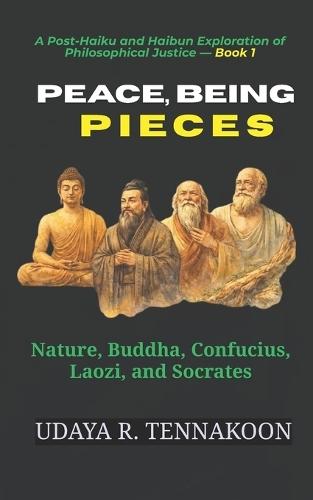
Peace, Being Pieces is a poetic-philosophical exploration of justice before law, before institutions, and before written authority. Moving across cosmology, ecology, ritual, and early philosophy, the book approaches justice not as a system to be imposed, but as a living practice-felt in breath, carried by rhythm, and remembered by land. Structured through post-haiku and post-haibun forms, the work resists linear argument and doctrinal closure. Instead, it listens. From the Big Bang and primordial circles to ancestral memory, drums, shadows, rivers, and forests, justice is traced as resonance rather than rule. Breath, sound, movement, and attention function as ethical forces through which order first emerges-not through command, but through relation. The book's philosophical core unfolds through encounters with four foundational figures: the Buddha, Confucius, Laozi, and Socrates. Each is approached not as a system-builder, but as a practitioner of justice-as-process. The Buddha reveals justice as the cessation of harm through the loosening of attachment. Confucius locates justice in cultivated relationship, ritual, and ethical conduct. Laozi opens justice toward non-action, balance, and ecological attunement. Socrates embodies justice as questioning-an ethical disturbance that resists certainty and power. Read together, these figures form a cross-cultural axis of thought that understands justice as lived inquiry rather than imposed order. Nature is not a backdrop in this work, but an ethical witness. Rivers judge by flow, forests remember without language, stones hold law without decree. Indigenous and pre-legal understandings of justice-embedded in land, ritual, and ancestral memory-are woven alongside classical philosophy, challenging modern assumptions that justice originates in written law or sovereign authority. Formally, Peace, Being Pieces introduces post-haibun and post-haiku as contemporary methods for philosophical writing. Fragmentation, repetition, and breath-units replace narrative resolution. Meaning arises relationally, inviting readers not merely to interpret but to inhabit. The text moves between prose, poetic compression, and reflective silence, mirroring the rhythms it describes. This is not a book that argues toward a conclusion. It listens, returns, and re-begins. Justice here is not adjudicated; it is practiced. It is found in attention, restraint, care, and the courage to remain open. In an age of juridical excess, ecological collapse, and political certainty, Peace, Being Pieces offers a quiet yet radical reorientation-toward justice as breath, rhythm, and shared becoming. Book 1 concludes with Socrates, marking the threshold between pre-legal and classical Western philosophy. Subsequent volumes will continue this inquiry through Plato and beyond. For now, this first book remains deliberately unfinished, returning the reader to breath, to listening, and to the unfinished work of justice itself.
Full Product Details
Author: Udaya R Tennakoon
Publisher: Independently Published
Imprint: Independently Published
Dimensions:
Width: 12.70cm
, Height: 0.90cm
, Length: 20.30cm
Weight: 0.159kg
ISBN: 9798244595031
Pages: 154
Publication Date: 19 January 2026
Audience:
General/trade
,
General
Format: Paperback
Publisher's Status: Active
Availability: Available To Order

We have confirmation that this item is in stock with the supplier. It will be ordered in for you and dispatched immediately.