|
|
|||
|
||||
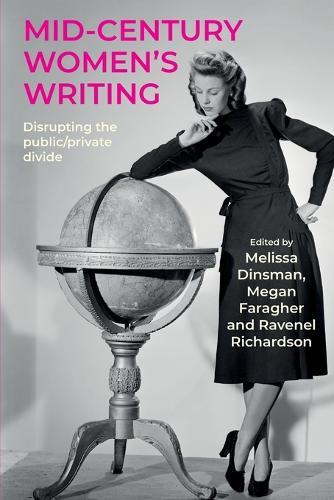
OverviewThe traditional narrative of the mid-century (1930s-60s) is that of a wave of expansion and constriction, with the swelling of economic and political freedoms for women in the 1930s, the cresting of women in the public sphere during the Second World War, and the resulting break as employment and political opportunities for women dwindled in the 1950s when men returned home from the front. But as the burgeoning field of interwar and mid-century women's writing has demonstrated, this narrative is in desperate need of re-examination. Mid-century women's writing: Disrupting the public/private divide aims to revivify studies of female writers, journalists, broadcasters, and public intellectuals living or working in Britain, or under British rule, during the mid-century while also complicating extant narratives about the divisions between domesticity and politics. Full Product DetailsAuthor: Melissa Dinsman , Megan Faragher , Ravenel RichardsonPublisher: Manchester University Press Imprint: Manchester University Press Dimensions: Width: 15.60cm , Height: 1.30cm , Length: 23.40cm Weight: 0.357kg ISBN: 9781526195517ISBN 10: 1526195518 Pages: 256 Publication Date: 20 January 2026 Audience: College/higher education , Postgraduate, Research & Scholarly Format: Paperback Publisher's Status: Active Availability: Not yet available, will be POD This item is yet to be released. You can pre-order this item and we will dispatch it to you upon it's release. This is a print on demand item which is still yet to be released. Table of ContentsIntroduction: Politicizing the domestic and domesticizing politics — Melissa Dinsman, Megan Faragher, and Ravenel Richardson Part I: Introduction - Professionalizing the domestic — Megan Faragher 1 Professional identity and personal space in Mary Renault’s Kind are her Answers and Return to Night— Victoria Stewart 2 Talking shop: Celia Fremlin and invisible work — Luke Seaber 3 ‘some thoroughly tiresome housekeeping crisis’: Rebecca West’s wartime journalism — Debra Rae Cohen 4 ‘Coldly kind’: Calculating care in post-war British women’s writing — Emily Ridge Part II - Introduction: Nationalizing gender politics – Melissa Dinsman 5 New world women and the Labour party win in Marghanita Laski’s The Village — Sarah E. Cornish 6 Beyond ‘companionate marriage’: Elizabeth Taylor’s gendered critique of post-war consensus in A View of the Harbour and A Wreath of Roses — Geneviève Brassard 7 Dissident friendship and revolutionary love in the novels of Sabitri Roy and Sulekha Sanyal — Sabujkoli Bandopadhyay 8 The political theory of heaven: Religious nationalism, mystical anarchism, and the Spanish Civil War in Sylvia Townsend Warner’s After the Death of Don Juan — Charles Andrews Part III - Introduction: Women beyond the nation — Ravenel Richardson 9 ‘A woman is always a woman!’: British women writers and refugees — Katherine Cooper 10 Families in a time of catastrophe: Anna Gmeyner’s Manja, 1920-1938 – Phyllis Lassner 11 ‘Some other land, some other sea’: Attia Hosain’s fiction and nonfiction in Distant Traveller – Ambreen Hai Bibliography Index -- .ReviewsAuthor InformationMelissa Dinsman is Associate Professor of English at York College, CUNY. Megan Faragher is Professor of English at Wright State University - Lake Campus. Ravenel Richardson is Director of Research Expansion and Development at Case Western Reserve University Tab Content 6Author Website:Countries AvailableAll regions |
||||