Overview
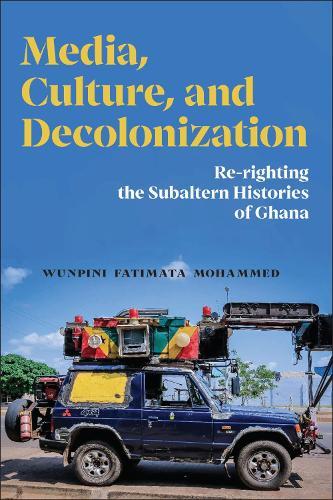
Media, Culture and Decolonization: Re-righting the Subaltern Histories of Ghana invites us to look at media and culture from a decolonial perspective. Through Dagbaŋ epistemologies and knowledge systems, this book examines media by highlighting how African languages, cultures and traditions can shift how we think of knowledge. It is an offering to anyone curious about the relationship between culture, language and media. By focusing on African language media in Ghana such as film, television and radio, the book emphasizes the importance of espousing a decolonial politic and praxis in the process of co-creating knowledge with indigenous communities. It connects the struggles of global majority countries and demonstrates the ways in which (neo)colonialism and imperialism impede the work toward liberatory futures. This book demonstrates the potential that African language media hold as tools of cultural and epistemological decolonization.
Full Product Details
Author: Wunpini Fatimata Mohammed
Publisher: Rutgers University Press
Imprint: Rutgers University Press
Weight: 0.454kg
ISBN: 9781978841642
ISBN 10: 1978841647
Pages: 186
Publication Date: 15 December 2025
Recommended Age: From 18 to 99 years
Audience:
College/higher education
,
Professional and scholarly
,
Professional and scholarly
,
Tertiary & Higher Education
,
Professional & Vocational
Format: Paperback
Publisher's Status: Active
Availability: Manufactured on demand

We will order this item for you from a manufactured on demand supplier.
Reviews
""Drawing from lived experience in Northern Ghana, collectively co-produced knowledge, attention to the materiality of language, and a radical feminist subaltern analysis, Mohammed offers a bold intervention in how we should theorize mediated culture in the global capitalist and colonial present."" --Paula Chakravartty ""James Weldon Johnson Professor of Media, Culture, and Communication at New York University"" ""This book is part of an unstoppable tidal shift in the center of knowledge production's gravity from Eurocentrism. Mohammed convincingly illustrates that the world takes on intricate hues and shapes when processed from the lens of indigeneity--a powerful tool to transform Africa(ns).""--Sylvia Tamale ""author of Decolonization and Afro-Feminism""
""This book is part of an unstoppable tidal shift in the center of knowledge production's gravity from Eurocentrism. Mohammed convincingly illustrates that the world takes on intricate hues and shapes when processed from the lens of indigeneity--a powerful tool to transform Africa(ns).""--Sylvia Tamale ""author of Decolonization and Afro-Feminism""
Author Information
WUNPINI FATIMATA MOHAMMED is an assistant professor in the Department of Communication at Cornell University. She is coeditor of African Women in Digital Spaces: Redefining Social Movements on the Continent and in the Diaspora.