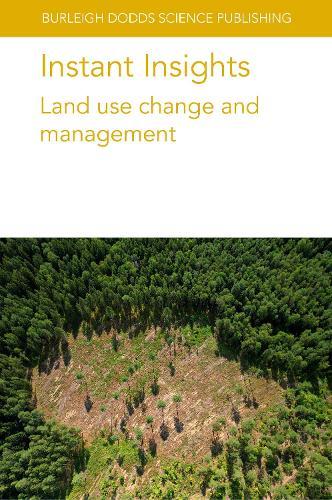
Overview
This book provides a detailed overview of the contribution of land use change to climate change, as well as the strategies and methods implemented to mitigate this impact and reverse global biodiversity decline, such as the development of agri-environment schemes.
Full Product Details
Author: Various authors , Dr Catherine Scott (University of Leeds) , Dr Lucas William Mendes (University of Sao Paulo) , Dr Liz Lewis-Reddy (ADAS)
Publisher: Burleigh Dodds Science Publishing Limited
Imprint: Burleigh Dodds Science Publishing Limited
Volume: 118
ISBN: 9781835452585
ISBN 10: 1835452582
Pages: 100
Publication Date: 25 November 2025
Audience:
College/higher education
,
Professional and scholarly
,
Tertiary & Higher Education
,
Professional & Vocational
Format: Paperback
Publisher's Status: Active
Availability: In Print 
This item will be ordered in for you from one of our suppliers. Upon receipt, we will promptly dispatch it out to you. For in store availability, please contact us.
Table of Contents
Chapter 1 - The role of agricultural expansion, land cover and land-use change in contributing to climate change: Catherine E. Scott, University of Leeds, UK; 1 Introduction 2 Impacts of land-use change on climate 3 Estimating the impacts of land-use change on climate 4 Role of the land sector in climate change mitigation 5 Future land-use trajectories 6 Future trends and conclusion 7 Where to look for further information 8 References Chapter 2 - Understanding how land-use management affects soil microbiomes: Lucas William Mendes, Alexandre Pedrinho and Thierry Alexandre Pellegrinetti, University of São Paulo, Brazil; and Dennis Goss-Souza, Institute of Paraná, Brazil; 1 Introduction 2 Effects of land-use change on soil microbiome composition 3 Effects of land-use change on soil microbiome functions 4 Effects of land recovery on soil microbiome properties 5 Future Perspectives 6 Where to look for further information 7 References Chapter 3 - Implementing sustainable land use change programmes: Liz Lewis-Reddy, ADAS Policy and Economics, UK; 1 Introduction 2 Sustainable land (SLM) management in a British context 3 Evolution of the concept of SLM: from from landscape protection to ecosystem service delivery 4 Challenges and lessons from implementing SLM programmes 5 Building capacity and capability within the farm business 6 Building capacity and capability around the farm business 7 Case study: Pumlumon Project 8 What the future could look like 9 Conclusion and future trends 10 Where to look for further information 11 References Chapter 4 - Agroforestry practices: riparian forest buffers and filter strips: Richard Schultz, Thomas Isenhart, William Beck, Tyler Groh and Morgan Davis, Iowa State University, USA; 1 Introduction 2 Riparian forest buffers 3 Riparian forest buffer design and function 4 Special design considerations and management 5 Assessing buffer performance 6 References
Reviews
Author Information
Dr Lucas William Mendes is an Assistant Professor on Ecogenomics and Environmental Sustainability at the Center for Nuclear Energy in Agriculture, University of Sao Paulo (CENA-USP), in Piracicaba-SP, Brazil. Dr Liz Lewis-Reddy is Director of ADAS Policy and Economics. With both her academic and professional background focused on revealing the cross-sectoral value (economic and ecological) of a healthy and resilient natural environment, Liz is a keen advocate of finding practical ways to do things differently and better for nature. She has UK wide experience of the means by which new markets can be established to trade the goods and services generated from sustainable land management. These include private and public sector agri-environment schemes, Nitrate and Carbon Trading platforms and blended finance instruments.
Tab Content 6
Author Website:
Countries Available
All regions
|