|
|
|||
|
||||
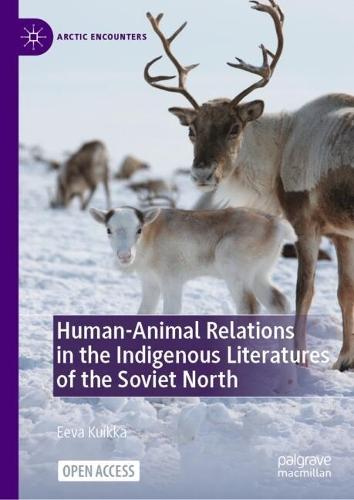
OverviewThis open access book examines how Indigenous authors from the Soviet North reflect the impact of Soviet settler colonialism on Indigenous communities in the region through literary engagement with human–animal relations. Careful analyses of works by Iurii Rytkheu (Chukchi), Anna Nerkagi (Nenets), and Eremei Aipin (Khanty) address the authors’ responses to Soviet colonialism and forced assimilation, as well as the ways in which these processes altered Indigenous cultures and conceptualizations of nature and non-human animals. The book situates Indigenous authors and their texts within the cultural, political, and ideological context of the Soviet Union, while simultaneously drawing on a broad array of theoretical frameworks – posthumanism, new materialism, and postcolonial criticism – to guide its analysis. The wealth of theoretical perspectives makes the book of interest to scholars and students in Soviet literary studies, Russian and Eurasian studies, Indigenous studies, environmental humanities, human-animal studies, and Arctic Studies. In the wake of Russia’s full-scale invasion of Ukraine and the emerged call to decolonize Russian and Eurasian studies, Human-Animal Relations in the Indigenous Literatures of the Soviet North offers a timely and necessary re-evaluation of Russia’s colonial history in the Arctic region. Full Product DetailsAuthor: Eeva KuikkaPublisher: Springer Nature Switzerland AG Imprint: Palgrave Macmillan ISBN: 9783032084149ISBN 10: 3032084148 Pages: 219 Publication Date: 03 January 2026 Audience: College/higher education , Postgraduate, Research & Scholarly Format: Hardback Publisher's Status: Active Availability: In Print This item will be ordered in for you from one of our suppliers. Upon receipt, we will promptly dispatch it out to you. For in store availability, please contact us. Table of ContentsChapter 1. Human-animal Relations in the Soviet North: Opening Remarks.- Chapter 2. Negotiating Human-Animal Boundaries through Transformation Narratives in Iurii Rytkheu’s When the Whales Leave and Teryky.- Chapter 3. Hybrids of the Soviet Modernity and Iurii Rytkheu’s Blue Foxes.- Chapter 4.Forming Subjects and Rhizomes Through Human-Animal Relations in Anna Nerkagi’s Aniko of the Nogo Clan.- Chapter 5.Narrating Colonial Slow Violence in Eremei Aipin’s Khanty, or the Star of the Dawn.- Chapter 6. Concluding Remarks and Reflections on the Post-Soviet Situation.ReviewsAuthor InformationEeva Kuikka is a postdoctoral researcher in Russian language and culture at Tampere University, Finland. She is specialized in Russian literature, postcolonial theory, human-animal studies, and gender studies. Her current research explores the intersections of gender and ethnicity in 20th -Century and contemporary Russian-language literature, art, and digital media. Kuikka’s previous publications include articles on Russophone Indigenous literatures, a co-authored article on “salmon geographies” (Jedele, Kuikka & Niska, 2024), and a co-authored monograph Contesting Feminism and Media Culture in Contemporary Russia: From Celebrities to Anti-war Activists (Ratilainen, Miazhevich, Zhaivoronok & Kuikka, 2025). Tab Content 6Author Website:Countries AvailableAll regions |
||||