Full Product Details
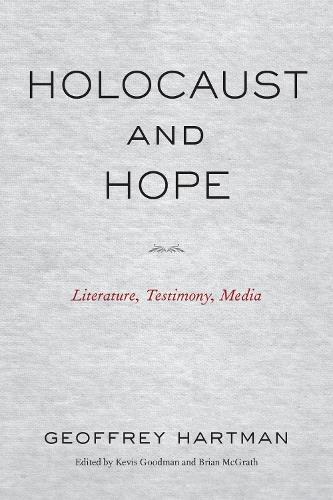
Author: Geoffrey Hartman ,
Kevis Goodman ,
Brian McGrath
Publisher: Fordham University Press
Imprint: Fordham University Press
Edition: New edition
ISBN: 9781531512217
ISBN 10: 1531512216
Pages: 240
Publication Date: 19 December 2025
Audience:
College/higher education
,
Professional and scholarly
,
Postgraduate, Research & Scholarly
,
Professional & Vocational
Format: Paperback
Publisher's Status: Active
Availability: Not yet available

This item is yet to be released. You can pre-order this item and we will dispatch it to you upon its release.
Reviews
""In this beautifully composed volume Geoffrey Hartman explores the important place of 'literary knowledge' in the aftermath of the Holocaust, insisting on the non-redemptive hope borne by an imaginative language that watches over 'absent meaning.' Framed by an excellent introduction and punctuated by an illuminating interview, Hartman's irreplaceable voice, returning posthumously to us at our own moment of political and ethical crisis, calls upon us to refuse the emptying out of language and thought typical of totalitarian movements and to find the future-oriented words that, like stars, can still have 'an independent existence, that hang glittering in the firmament of discourse.'""---Cathy Caruth, Cornell University
Author Information
Geoffrey Hartman (Author) Geoffrey Hartman was Sterling Professor of English and Comparative Literature at Yale University and Project Director of its Fortunoff Video Archive for Holocaust Testimonies. His many books include The Third Pillar: Essays in Judaic Studies (2011), A Scholar’s Tale: Intellectual Journey of a Displaced Child of Europe (2007), The Geoffrey Hartman Reader (2004, winner, Truman Capote Prize for Literary Criticism), Scars of the Spirit: The Struggle Against Inauthenticity (2004), The Fateful Question of Culture (1997), The Longest Shadow: In the Aftermath of the Holocaust (1996), The Unremarkable Wordsworth (1987), Criticism in the Wilderness: The Study of Literature Today (1980, 2nd ed., 2007), The Fate of Reading and Other Essays (1975), Beyond Formalism: Literary Essays, 1958–1970 (1970), and Wordsworth’s Poetry, 1787–1814 (1964, winner, Christian Gauss Award). Kevis Goodman (Edited By) Kevis Goodman is Professor and John F. Hotchkis Chair in English at the University of California, Berkeley. She is the author of Pathologies of Motion: Historical Thinking in Medicine, Aesthetics, and Poetics (2023) and Georgic Modernity and British Romanticism: Poetry and the Mediation of History (2004). Brian McGrath (Edited By) Brian McGrath is Professor of English at Clemson University. He is the author of Look Round for Poetry: Untimely Romanticisms (2022) and The Poetics of Unremembered Acts: Reading, Lyric, Pedagogy (2013).