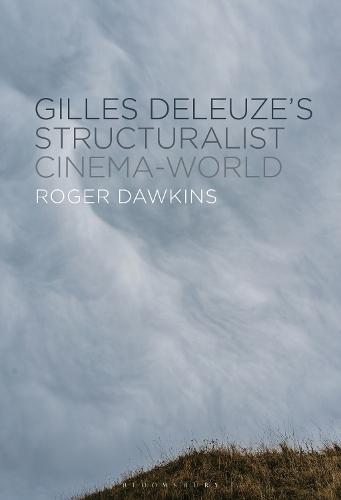
Full Product Details
Author: Roger Dawkins (Western Sydney University, Australia)
Publisher: Bloomsbury Publishing Plc
Imprint: Bloomsbury Academic
Dimensions:
Width: 16.00cm
, Height: 1.80cm
, Length: 23.00cm
Weight: 0.460kg
ISBN: 9798765128275
Pages: 224
Publication Date: 08 January 2026
Audience:
Professional and scholarly
,
Professional & Vocational
Format: Hardback
Publisher's Status: Active
Availability: Manufactured on demand

We will order this item for you from a manufactured on demand supplier.
Reviews
This book offers a genuinely new approach to cinema studies—a welcome foregrounding of Deleuze’s account of structure developed in his early philosophy. Dawkins demonstrates how Deleuze transformed key ideas of orthodox structuralism and how he critiqued the representational thinking that is so ingrained in cinema studies. But Dawkins does not simply explicate Deleuze; he also formulates an interpretive method of structural analysis that promotes non-representational thinking, which rejects sameness and negativity by recognizing novelty, creativity, and experimentation. * Warren Buckland, Associate Professor of Film, Oxford Brookes University, UK * To escape fascism and discover the possibility of thinking differently, me might need more structures. This is Dawkins’ radical claim for using structuralism to develop a novel framework of Deleuzian film analysis, shedding light on contemporary visual cultures from Aboriginal cinema to Instagram trends. * Laurence Kent, Lecturer in Digital Film and Television, University of Bristol, UK *
This book offers a genuinely new approach to cinema studies—a welcome foregrounding of Deleuze’s account of structure developed in his early philosophy. Dawkins demonstrates how Deleuze transformed key ideas of orthodox structuralism and how he critiqued the representational thinking that is so ingrained in cinema studies. But Dawkins does not simply explicate Deleuze; he also formulates an interpretive method of structural analysis that promotes non-representational thinking, which rejects sameness and negativity by recognizing novelty, creativity, and experimentation. * Warren Buckland, Associate Professor of Film, Oxford Brookes University, UK * To escape fascism and discover the possibility of thinking differently, we might need more structures. This is Dawkins’ radical claim for using structuralism to develop a novel framework of Deleuzian film analysis, shedding light on contemporary visual cultures from Aboriginal cinema to Instagram trends. * Laurence Kent, Lecturer in Digital Film and Television, University of Bristol, UK *
Author Information
Roger Dawkins is Associate Dean of Learning and Teaching at Western Sydney University, Australia. His research interests include Deleuze studies; film-philosophy; media studies (including social media); podcasting; the scholarship of teaching and learning; technology enhanced learning (TEL); and learning analytics (LA). He teaches in media theory, media law and ethics, podcasting, screen media and data visualization.