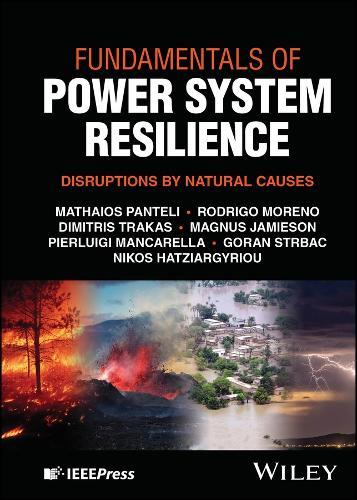
Fundamentals of Power System Resilience: Disruptions by Natural Causes

Author:   Mathaios Panteli (University of Cyprus, Cyprus) ,  Rodrigo Moreno (University of Chile, Chile) ,  Dimitris Trakas (National Technical University of Athens, Greece) ,  Magnus Jamieson (Imperial College London, UK)
Publisher:   John Wiley & Sons Inc
ISBN:  

9781119815990


Pages:   272
Publication Date:   19 January 2026
Format:   Hardback
Availability:   Awaiting stock   Availability explained


Our Price $223.95 Quantity:  
Pre-Order

Share |

Fundamentals of Power System Resilience: Disruptions by Natural Causes


Overview

Comprehensive resource focusing on natural hazards and their impact on power systems, with case studies and tutorials included Fundamentals of Power System Resilience is the first book to cover the topic of power system resilience in a holistic manner, ranging from novel conceptual frameworks for understanding the concept, to advanced assessment and quantifying techniques, to optimization planning algorithms and regulatory frameworks towards resilient power grids. The text explicitly addresses the needs and challenges of current network planning and operation standards and examines the steps and standard amendments needed to achieve low-carbon, resilient power systems. Practically, it provides frameworks to assess resilience in operation and planning and relevant quantification metrics. Case studies from around the world (real data and project developments as well as simulations) including windstorms, wildfires, floods, earthquakes, blackouts, and brownouts, etc. are included, with applications from the UK, Chile, Australia, and Greece. In Fundamentals of Power System Resilience, readers can expect to find specific information on: Classical reliability standards, covering the changing energy landscape and limitations of existing reliability-driven network planning and operation standards How resilience is interpreted in the power systems community, and characterizations and differentiation of threats Spatiotemporal impact assessment of external shocks on power systems, trapezoid applications to different events of different time-scales, and AC cascading models for resilience applications Conventional approaches to asset failure data representation and modeling of the relationship between weather/asset outages Fundamentals of Power System Resilience provides fundamental knowledge of the subject and is an excellent supplementary reference for final undergraduates and postgraduate students due to its mix of basic and advanced content and tutorial-like exercises. It is also essential for regulators and practitioners for shaping the future resilient power systems.

Full Product Details

Author:   Mathaios Panteli (University of Cyprus, Cyprus) ,  Rodrigo Moreno (University of Chile, Chile) ,  Dimitris Trakas (National Technical University of Athens, Greece) ,  Magnus Jamieson (Imperial College London, UK)
Publisher:   John Wiley & Sons Inc
Imprint:   Wiley-IEEE Press
Weight:   0.666kg
ISBN:  

9781119815990


ISBN 10:   1119815991
Pages:   272
Publication Date:   19 January 2026
Audience:   Professional and scholarly ,  Professional & Vocational
Format:   Hardback
Publisher's Status:   Forthcoming
Availability:   Awaiting stock   Availability explained

Table of Contents

About the Authors xi Foreword by Professor Chongqing Kang xv Foreword by Professor Ian Dobson xvii Preface xix 1 From Reliability to Resilience 1 1.1 Why Power System Resilience? 1 1.2 The Historical Approaches to Power System Reliability 3 1.3 Need for a (Tail)Risk-Aware Approach 4 1.4 Inspiration from Other Economic and Engineering Areas 5 1.5 From Reliability to Resilience Paradigm 7 1.6 Fundamentals of Power System Resilience 9 2 Conceptualizing and Contextualizing Power Grid Resilience 13 2.1 Shocks and Stresses on Critical Power Infrastructure 13 2.2 Defining Power System Resilience 15 2.3 Resilience Capacities and Features 18 2.4 Comparing and Clarifying Reliability and Resilience 20 2.5 Conceptualizing Power System Resilience to External Shocks 22 2.6 Domains of Resilience 26 3 System Resilience Assessment and Quantification 31 3.1 Needed Resilience Metrics for Power Systems 31 3.2 Quantifying the Resilience Trapezoid 32 3.3 CVaR-Driven Resilience Assessment 43 3.4 AC Cascading Modeling for Resilience Applications 45 4 Addressing Data Granularity and Ambiguity 61 4.1 Understanding Outage Models on Power Systems 61 4.2 Homogeneous Versus Distributed Representations of Failure Hazard on Overhead Lines 66 4.3 Distributed Failure Risk Representation on Lines 67 4.4 Method for Representing Spatial Risk of a Natural Hazard 70 4.5 Data Acquisition 70 4.6 Exercises 84 4.7 Correlated Natural Hazards 86 4.8 Incorporating Imprecise Fragility Curves in Decision-Making Models 90 4.9 Summary 91 5 Resilient Investment Planning 95 5.1 Network Investment Decisions: Unraveling the Planner's Trilemma 95 5.2 Resilience and Risk Metrics for Risk-Averse Decision-Making 98 5.3 Mathematical Frameworks to Plan Resilient Grids 104 5.4 Merging Resilience and Reliability Criteria for Practical Decisions 110 5.5 Realistic Application to Earthquakes in Chile 113 5.6 Main Grid Resilience Investments Versus DER 116 5.7 Investment Versus Operational Measures 121 5.8 Fairness Considerations in Resilience 122 5.9 Beyond Networks: Long-Term Duration Energy Storage to Enhance Future Energy System Resilience Against Prolonged Low Output of RES 124 6 Operational Resilience Planning 131 6.1 Introduction 132 6.2 Smart Operational Measures 135 6.3 Preventive Unit Commitment to Enhance Power System Resilience Under Extreme Weather Events 136 6.4 Defensive Islanding to Enhance Power System Resilience Under Extreme Weather Events 151 6.5 Resilience Enhancement in Low-Carbon, Low-Inertia Power Systems 160 6.6 Appendix 167 7 Resilience by Distributed Energy Resources and Microgrids 177 7.1 Local and Bulk System Resilience 177 7.2 Resilience Support by Real-World Microgrids 181 7.3 DER/Microgrids Role in Strengthening Resilience 187 7.4 Preventive and Corrective Microgrid Formation 189 7.5 Microgrids for Resilience-Oriented Restoration 201 7.6 Resilience-Oriented Preventive and Emergency DER Scheduling 207 8 Resilience of Low-Carbon Power Systems: Standards, Market, Regulatory, and Policy Aspects 221 8.1 Introduction 221 8.2 Weather and Low-Carbon Grid Reliability 221 8.3 Weather and Low-Carbon Grid Resilience 222 8.4 From Reliability to Resilience in Low-Carbon Grids: Need for New Security Standards 223 8.5 Toward a New Regulatory Framework for Resilience 225 8.6 Measuring Power System Resilience 227 8.7 The Economics of Resilience: 'Value of Customer Resilience' and Risk Aversion 229 8.8 The Economics of Resilience: Cost–Benefit Analysis and Risk Aversion 232 8.9 The Economics of Resilience: Cost-Effectiveness Analysis 232 8.10 Regulation, Policy, and Markets: Who Should Provide Resilience? 233 8.11 Regulation, Policy and Markets: Who Should Pay for Resilience? 235 8.12 Resilience, Decarbonization Policies, and Digitalization Paradigm 235 8.13 A Regulatory Perspective on Resilience: Final Considerations 237 References 238 Index 241

Reviews

Author Information

Mathaios Panteli, Assistant Professor, University of Cyprus. Rodrigo Moreno, Assistant Professor, University of Chile. Dimitris Trakas, Senior Researcher, National Technical University of Athens, Greece. Magnus Jamieson, Research Associate, Imperial College London, UK. Pierluigi Mancarella, Chair Professor of Electrical Power Systems, University of Melbourne, Australia, and Professor of Smart Energy Systems, University of Manchester, UK. Goran Strbac, Chair Professor in Electrical Energy Systems, Imperial College London, UK. Nikos Hatziargyriou, Professor in Power Systems, National Technical University of Athens, Greece.

Tab Content 6

Author Website:  

Countries Available

All regions
Latest Reading Guide

NOV RG 20252


Shopping Cart
Your cart is empty
Shopping cart
Mailing List