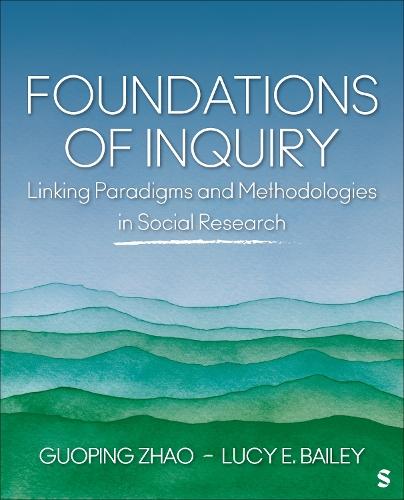
Foundations of Inquiry: Linking Paradigms and Methodologies in Social Research

Author:   Guoping Zhao ,  Lucy E. Bailey
Publisher:   SAGE Publications Inc
ISBN:  

9781071846070


Pages:   344
Publication Date:   05 December 2025
Format:   Paperback
Availability:   In Print   Availability explained
This item will be ordered in for you from one of our suppliers. Upon receipt, we will promptly dispatch it out to you. For in store availability, please contact us.

Our Price $227.70 Quantity:  
Add to Cart

Share |

Foundations of Inquiry: Linking Paradigms and Methodologies in Social Research


Overview

Full Product Details

Author:   Guoping Zhao ,  Lucy E. Bailey
Publisher:   SAGE Publications Inc
Imprint:   SAGE Publications Inc
Weight:   0.630kg
ISBN:  

9781071846070


ISBN 10:   1071846078
Pages:   344
Publication Date:   05 December 2025
Audience:   College/higher education ,  Postgraduate, Research & Scholarly
Format:   Paperback
Publisher's Status:   Active
Availability:   In Print   Availability explained
This item will be ordered in for you from one of our suppliers. Upon receipt, we will promptly dispatch it out to you. For in store availability, please contact us.

Table of Contents

Introduction and Overview Acknowledgments About the Authors Part I Chapter 1: The Legacy of Positivism in Social Research Origins and Development of Positivism Positivism and Empirical Research: Embedded Assumptions & Guiding Beliefs Critique and Fall from Prominence Positivist Legacy Review Questions and Prompts Chapter 2: Post-Positivism The Rise of Post-Positivism Post-Positivism as a Paradigm Implications for Methodology Discussion Examples of Post-Positivist Research Review Questions and Prompts Part II Chapter 3: General Interpretivism The Rise of General Interpretivism The Interpretivist Turn and Constructionist Philosophy General Interpretivism as a Paradigm Discussion Implications for methodology Examples of Interpretivist Research Review Questions and Prompts Chapter 4: Phenomenology Husserl’s Transcendental Phenomenology Martin Heidegger’s Hermeneutical Phenomenology Maurice Merleau-Ponty’s Existential Phenomenology Phenomenology as Philosophical Reflection Method Phenomenology as a Paradigm for the Social Sciences Discussion Implications for Methodology Examples of Phenomenological Inquiry Review Questions and Prompts Chapter 5: Hermeneutics Modern Hermeneutics Hermeneutics as a Paradigm for Social Research Discussion Methodological Implications Examples of Hermeneutic Study Review Questions and Prompts Chapter 6: Symbolic Interactionism The Rise of Sociology and the Chicago School Symbolic Interactionism as a Paradigm Methodological Alignment With SI: Ethnography Discussion Implications for Methodology Examples of Symbolic Interactionism Research Review Questions and Prompts Part III Chapter 7: Critical Theory Prelude: Marx and the Critical Perspective The Rise of Western Marxism and the Frankfurt School Critical Theory Critical Theory as a Paradigm Implications for Methodology: Critical Inquiry Discussion Examples of Critical Inquiry Review Questions and Prompts Chapter 8: Critical Race Theory History, Development, and Responses Core Propositions of CRT CRT as a Paradigm Implications for Methodology: CRT’s Methodological Innovations Discussion Examples of and Resources for Critical Race Studies Review Questions and Prompts Chapter 9: Feminism The Feminist Movement and the Rise of Feminist Epistemology Feminist Perspective Feminist Perspective as A Paradigm Implications for Methodology: Feminist Research Discussion Examples of Feminist Research Review Questions and Prompts Chapter 10: Philosophical Grounding for Mixed Methods Research The Rise of Mixed Methods Research The Struggle for Philosophical Justification: The Paradigmatic Stances The Struggle for Philosophical Justification: Paradigms for MMR Discussion: The Current State of MMR Examples of Mixed Methods Research Review Questions and Prompts Part IV Chapter 11: Post-Structuralism The Development of Poststructuralism Diverse Components of Poststructuralism Poststructuralism as a Paradigm Discussion Implications for Methodology Examples of Poststructuralist Research Review Questions and Prompts Chapter 12: Indigenous Paradigms Indigenous Worldviews and Ways of Knowing The Legacy of Colonization and the Decolonizing Inquiry Practices The Emergence of Indigenous Paradigms Implications for Methodology Discussion Examples of Research Approaches that Honor and Exemplify Indigenous Ways of Knowing and Commitments Questions References Index

Reviews

This book dives into the importance of understanding your paradigm and approach to research before starting a project, thus providing students with a good foundation to conduct high quality research. -- Gudrun Nyunt


Author Information

Guoping Zhao is a Professor at Oklahoma State University, USA. She works in the fields of continental philosophy, comparative philosophy, philosophy of education, and theoretical foundations of inquiry. She is the author of Subjectivity and Infinity: Time and Existence (2020, Palgrave MacMillan), the editor of Levinas and the Philosophy of Education (2018, Routledge), and the co-editor of Re-Envisioning Chinese Education: The Meaning of Person-Making in a New Age (2015, Routledge). Lucy E. Bailey is professor at Oklahoma State University and Director of Gender, Women’s and Sexuality Studies. She conducts research and teaches in the fields of qualitative methodologies, feminist and diversity studies, and foundations of education. She is co-editor of the Research in Life Writing and Education book series (Emerald Press) and has published co-edited books on race and life writing, educational embodiment, and women’s civil war letter writing.

Tab Content 6

Author Website:  

Countries Available

All regions
Latest Reading Guide

NOV RG 20252


Shopping Cart
Your cart is empty
Shopping cart
Mailing List