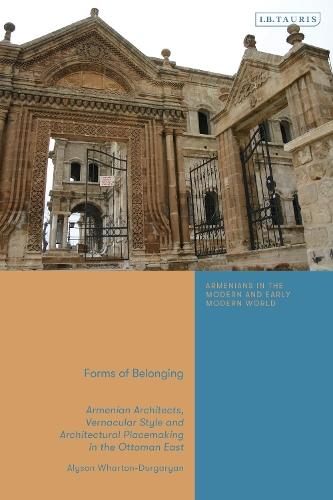
Full Product Details
Author: Alyson Wharton-Durgaryan
Publisher: Bloomsbury Publishing PLC
Imprint: I.B. Tauris
Dimensions:
Width: 19.40cm
, Height: 2.20cm
, Length: 24.80cm
Weight: 0.580kg
ISBN: 9780755655076
ISBN 10: 0755655079
Pages: 256
Publication Date: 11 December 2025
Audience:
College/higher education
,
Professional and scholarly
,
Tertiary & Higher Education
,
Professional & Vocational
Format: Hardback
Publisher's Status: Active
Availability: Manufactured on demand

We will order this item for you from a manufactured on demand supplier.
Reviews
An admirable and innovative study that opens new perspective on the history of Ottoman architecture and its culture. By focusing on the contribution of Armenians to the religious as well as secular architecture of East Anatolia, a region with multiple ethnicities and faiths and remote from the centre of power, the book reveals multi-layered aspects of artistic and cultural interaction. It is a pioneer work and as, the author herself says, this book is just the beginning of a field that is ripe for further investigations. * Doris Behrens-Abouseif, Professor, SOAS, UK * This book makes a bold and timely case for recognizing Armenian architecture as central to the remaking of the Ottoman East. Rather than merely documenting lost heritage, it argues that distinctive Armenian architectural forms emerged from the lived experiences of Armenians in cities like Mardin, Antep, Urfa, Diyarbakir, Bitlis, and Erzurum. Drawing on architectural analysis, archival sources, and memory books, it reveals how Armenians navigated belonging and visibility within a changing imperial landscape. This is a landmark contribution to the urban history of the Islamic world and a deeply significant intervention in understanding Armenian presence, creativity, and resilience amid marginalization and erasure in the Ottoman empire. * Mohammad Gharipour, Professor, University of Maryland, USA *
An admirable and innovative study that opens new perspective on the history of Ottoman architecture and its culture. By focusing on the contribution of Armenians to the religious as well as secular architecture of East Anatolia, a region with multiple ethnises and faiths and remote from the centre of power, the book reveals multi-layered aspects of artistic and cultural interaction. It is a pioneer work and as, the author herself says, this book is just the beginning of a field that is ripe for further investigations. * Doris Behrens-Abouseif, Professor, SOAS, UK * This book makes a bold and timely case for recognizing Armenian architecture as central to the remaking of the Ottoman East. Rather than merely documenting lost heritage, it argues that distinctive Armenian architectural forms emerged from the lived experiences of Armenians in cities like Mardin, Antep, Urfa, Diyarbakir, Bitlis, and Erzurum. Drawing on architectural analysis, archival sources, and memory books, it reveals how Armenians navigated belonging and visibility within a changing imperial landscape. This is a landmark contribution to the urban history of the Islamic world and a deeply significant intervention in understanding Armenian presence, creativity, and resilience amid marginalization and erasure in the Ottoman empire. * Mohammad Gharipour, Professor, University of Maryland, USA *
Author Information
Alyson Wharton-Durgaryan, is Senior Lecturer at Lincoln School of Humanities and Heritage, University of Lincoln, UK. She was previously Assistant Professor in the Department of Art History at Mardin Artuklu University, Turkey. She is the author of The Architects of Ottoman Constantinople (2015, I.B.Tauris).