Overview
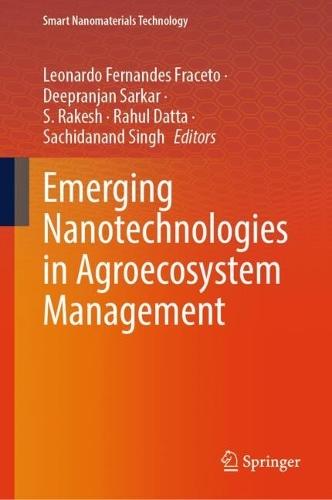
This book covers the challenges and applications of nanotechnology for managing agroecosystems from maintaining seed quality and ends with food packaging and processing. It covers the use of nanocomposites to manage seed germination, nutrition, biotic and abiotic stresses, and the productivity of crops and the use of nanosensors in detecting pests, pathogens, and pollutants and forecasting soil and crop health. In addition, it also focuses on the risk assessment and regulatory policies of nanoparticles to explore the potential of smart delivery systems in agroecosystems. The book is helpful for students, researchers, growers, policymakers, in the field of nanotechnology in agriculture, sustainable agriculture, soil science, and environmental science.
Full Product Details
Author: Leonardo Fernandes Fraceto ,
Deepranjan Sarkar ,
S. Rakesh ,
Rahul Datta
Publisher: Springer Verlag, Singapore
Imprint: Springer Verlag, Singapore
ISBN: 9789819501861
ISBN 10: 9819501865
Pages: 427
Publication Date: 22 January 2026
Audience:
College/higher education
,
Professional and scholarly
,
Tertiary & Higher Education
,
Professional & Vocational
Format: Hardback
Publisher's Status: Active
Availability: Not yet available

This item is yet to be released. You can pre-order this item and we will dispatch it to you upon its release.
Author Information
Leonardo Fernandes Fraceto earned a bachelor’s degree in Chemistry (1997), a master’s degree in Functional and Molecular Biology (2000), and a Ph.D. in Functional and Molecular Biology (2003) from the State University of Campinas, Brazil. He is currently an Associate Professor at the Institute of Science and Technology, São Paulo State University (UNESP), Campus Sorocaba, where he teaches in the Environmental Engineering undergraduate program and the postgraduate program in Environmental Sciences. He also served as Coordinator of the Postgraduate Program in Environmental Sciences at UNESP–Sorocaba from 2012 to 2016. His research expertise spans chemistry and biochemistry, with a strong emphasis on environmental nanotechnology and the application of nanotechnology in agriculture. Dr. Fraceto has developed nanocarrier systems for herbicides and other bioactive compounds for pest management in agriculture, resulting in numerous research publications and patents. He continues to actively work on the development of nanocarrier systems for the encapsulation of compounds with bioactive properties. Deepranjan Sarkar is working as a Postdoctoral Research Fellow at the Department of Food, Agriculture and Natural Resources, School of Environment, Resources and Development, Asian Institute of Technology (AIT), Thailand. Before joining AIT, he served as an Assistant Professor (Soil Science) at the Integral University, Lucknow, India, and also as a Consultant at the International Rice Research Institute (IRRI), India. He received M.Sc. (Ag.) in Soil Science and Agricultural Chemistry degree from Uttar Banga Krishi Viswavidyalaya and Ph.D. from Banaras Hindu University, India. His research interests include soil fertility, plant nutrition, regenerative agriculture, carbon sequestration, climate change, and UNSDGs. During his Ph.D. program, he performed a comprehensive assessment of bio-priming technology in the Middle Gangetic Plains of India and presented his research at several national and international conferences. Dr. Sarkar is involved in teaching soil science courses at UG and PG levels. Currently, he is working on prioritizing adaptation options to address expected future climate challenges in agroecosystems. He has received prestigious awards from BHU, IIT-KGP, TWAS, and the Soil Science Society of America. He is a Life Member/Member of AMI-India, ISCA-Kolkata, IUCN, etc. He has authored more than 30 peer-reviewed publications. He serves on the Editorial Board of Discover Agriculture (Springer Nature) and Modern Agriculture (Wiley), is a Review Editor in Frontiers journals, and regularly reviews manuscripts for journals published by Springer, Elsevier, Taylor & Francis, Wiley, and others. S. Rakesh is currently serving as an Associate Scientist in the Department of Resilient Farming Systems at the International Crops Research Institute for the Semi-Arid Tropics (ICRISAT), Hyderabad, India. He previously worked as a Research Associate at ICARNational Academy of Agricultural Research Management (NAARM), Hyderabad (2019-2023) and as a Senior Research Fellow in the Australian (ACIAR) funded project “Sustainable & Resilient Farming System Intensification (SRFSI)” from 2015 to 2019. His Ph.D. research focused on carbon dynamics and conservation agricultural practices. Dr. Rakesh has received several awards, including the Best ThesisAward (2019), Young Scientist Award (2021), and Young Researcher Award (2023). Currently, he is working on research projects specifically in the area of regenerative agriculture and sustainable crop production through climate adaptation technologies. Dr. Rakesh is a member of several professional societies and organizations like SEE-Agra, ISCA-Kolkata, COBACAS, IUCN, etc. He is actively involved in delivering invited lectures at conferences and Universities and participating in extension works with numerous Farmer’s Clubs. He has published more than 50 full length research in reputed international and national journals, with an H-index of 16. Dr. Rakesh has served as editor of two books. He has served as editor of two books, acts as a reviewer for journals published by Elsevier, Springer, and Frontiers, and is an Editorial Board Member of Discover Agriculture (Springer). Rahul Datta is an Assistant Professor of Soil Science at Mendel University, Brno, Czech Republic, recognized for his notable contributions to sustainable agriculture. His research addresses critical challenges such as drought stress, heavy metal toxicity, and greenhouse gas emissions, significantly enhancing the quality and yield of crops like wheat, maize, barley, rice, mangoes, spinach, and cotton. With over 200 peer-reviewed publications and more than 10,000 citations worldwide, including acknowledgments from institutions like the USDA, Dr. Datta has earned an H-index of 54, underscoring the impact of his work. His achievements also earned him a place in the Top 2% of Scientists as per Stanford University Ranking of World Scientists, recognizing his global influence in the field. Dr. Datta has authored 10 books, contributed to 20 book chapters, and holds 6 patents, further solidifying his leadership in agricultural science. In addition to his research, Dr. Datta holds several editorial roles. He is an Academic Editor for the Turkish Journal of Agriculture and Forestry, serves on the Editorial Board of BMC Plant Biology, and is an Editor for Open Agriculture (De Gruyter) and Phyton-International Journal of Experimental Botany. As a member of the Soil Science Society of America, Dr. Datta remains at the forefront of advancing soil science and sustainable agriculture through his research, publications, and editorial contributions. Sachidanand Singh is currently working as an Associate Professor and Head in the Department of Biotechnology, School of EnergyTechnology, PanditDeendayal Energy University, Gandhinagar, Gujarat, India. He has an engineering background, having earned a B.Tech in Biotechnology and an M.Tech in Bioinformatics, followed by a PhD, and completed postdoctoral research at The Ohio State University, College of Pharmacy, USA. He has more than 14 years of experience in teaching, administration, and research. He has previously served as Professor and Head Internal Quality Assurance Cell and Dean of Allied Sciences at Sankalchand Patel University, Gujarat, Dean of Biotechnology and Agriculture Sciences, NAAC SSR Head, and Research Coordinator at Shri Ramswaroop Memorial University. Work experience includes Karunya University, Shri Ramswaroop Memorial University, Vignan University, and Sankalchand Patel University. His research area includes Plant Biotechnology, metagenomics, Systems Biology, Network Biology, Micro RNA-based studies, Expression Data Analytics, Nextgeneration Sequencing, and Statistical Genetics. His present focus also includes understanding the Canonical and non-canonical pathways of miRNABiogenesis, Dynamics, and mechanisms of miRNA-mediated Gene Regulation. He teaches different subjects, especially Genomics and Proteomics, Microarray and Image Analysis, Drug Design, and Molecular Modeling for graduate and postgraduate students. He has been involved in various assignments given by the University authority from time to time, such as Online teaching platform, Research Initiatives, Biogas Plant, NAAC, NBA, and other council approvals. He has published more than 60 research and review articles in peer-reviewed journals, 9 Patents published among which 4 are granted. He has completed one SERB, Govt. of India-funded project, and two University research grant projects. He has received several awards in his area of research and for his teaching strategies. He has organized different conferences and workshops and received Govt. funds for the same. He has shared his area of expertise with different colleges and universities as an invited speaker at different conferences and workshops. He has guided 36 B.Tech and 10 M.Tech projects. He has awarded 3 PhD students under him in the field of Herbal products, drug Design, and integration with network biology.