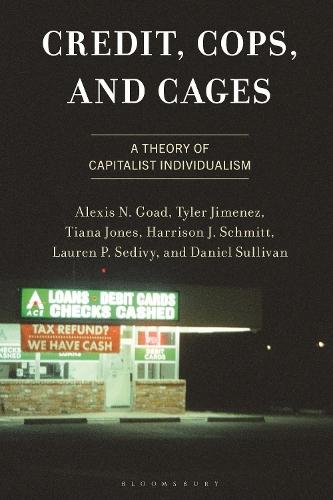
Overview
Longstanding debates about neoliberalism in the United States center around whether it has created a culture of entrepreneurial selfhood or a carceral state. Credit, Cops, and Cages presents a novel theory and relevant empirical evidence arguing that capitalist individualism combines both of these tendencies. The book’s interdisciplinary authors first derive a critical framework and set of social-psychological hypotheses from the long-neglected criminological writings of the early Frankfurt School. They then test and explore these hypotheses with new data and analyses in a series of chapters that guide the reader down the ladder of capitalist individualism. In the process, the authors synthesize and critically examine scholarship of Constitutional law; big data on indebtedness, segregation, and police militarization; psychological surveys capturing and comparing attitudes and emotions around debt and policing; and the intimate testimony of those who are deeply in debt or are currently incarcerated. Unique in its combination of philosophy and social scientific research, this book restores the relevance of the Frankfurt School’s ideas and methods to a comprehensive understanding of contemporary U.S. society.
Full Product Details
Author: Alexis N. Goad ,
Tyler Jimenez ,
Tiana Jones ,
Harrison J. Schmitt
Publisher: Bloomsbury Publishing Plc
Imprint: Rowman & Littlefield
Dimensions:
Width: 15.20cm
, Height: 2.00cm
, Length: 23.20cm
Weight: 0.520kg
ISBN: 9781666946161
ISBN 10: 1666946168
Pages: 256
Publication Date: 05 February 2026
Audience:
Professional and scholarly
,
Professional & Vocational
Format: Hardback
Publisher's Status: Active
Availability: Manufactured on demand

We will order this item for you from a manufactured on demand supplier.
Reviews
Credit, Cops, and Cages: A Theory of Capitalist Individualism offers a powerful and incisive account of how neoliberal capitalism in the contemporary United States produces a paradoxical condition: individuals are promised autonomy while subjected to intensifying legal, economic, and carceral constraints. Through a critical engagement with the neglected criminological writings of the early Frankfurt School—including Rusche, Kirchheimer, Fromm, Horkheimer, Marcuse, Neumann, and Benjamin—the authors illuminate how capitalist political economy and its institutional apparatuses generate a stratified social order of disciplined, precarious, and incarcerated selves. This timely and important work offers a prescient analysis of past and present conditions while challenging social psychologists to actively build institutions that minimize structural oppression and psychological immiseration. * Sheldon Solomon, Skidmore College *
Author Information
Alexis N. Goad is a PhD candidate in social psychology at the University of Arizona. Tyler Jimenez is assistant professor of psychology at the University of Arizona. Tiana Kathryn Jones works as a Deputy State Public Defender for the Colorado State Public Defender. Harrison J. Schmitt is assistant professor in the Department of Psychology at Skidmore College. Lauren P. Sedivy is an existential psychologist and prison reform advocate whose research focuses on supporting rehabilitation and successful reentry for incarcerated individuals. Daniel Sullivan is the director of the Social and Personality Psychology Program at the University of Arizona in Tucson.