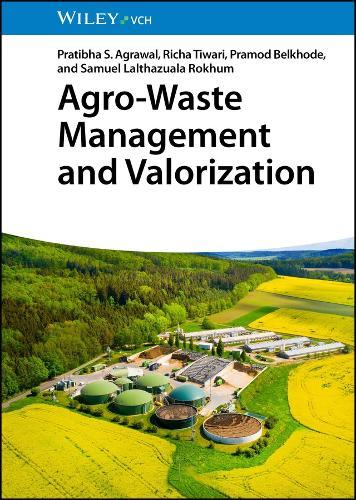
Agro-Waste Management and Valorization

Author:   Pratibha S. Agrawal (Laxminarayan Innovation Technological University, Nagpur, India) ,  Richa Tiwari (Laxminarayan Innovation Technological University, Nagpur, India) ,  Pramod N. Belkhode (Laxminarayan Innovation Technological University, Nagpur, India) ,  Samuel Lalthazuala Rokhum (National Institute of Technology Silchar, India)
Publisher:   Wiley-VCH Verlag GmbH
ISBN:  

9783527355754


Pages:   400
Publication Date:   28 January 2026
Format:   Hardback
Availability:   Awaiting stock   Availability explained
The supplier is currently out of stock of this item. It will be ordered for you and placed on backorder. Once it does come back in stock, we will ship it out for you.

Our Price $295.95 Quantity:  
Add to Cart

Share |

Agro-Waste Management and Valorization


Overview

Presents cutting-edge insights on transforming agricultural waste into renewable energy, sustainable materials, and economic opportunities The urgent need to transition toward sustainable development has propelled agro-waste management to the forefront of global research and policy initiatives. Agricultural residues, once treated as environmental burdens, now offer vast potential as renewable feedstocks for biofuels, compost, and biochar, as well as for driving innovations in the circular economy. Agro-Waste Management and Valorization provides an authoritative and comprehensive overview of the scientific, technological, and economic frameworks required to turn agricultural waste into valuable resources. Through a multidisciplinary lens, the authors examine the chemistry, engineering, and environmental principles that shape modern waste-to-value pathways, while situating these approaches within relevant legislative and policy contexts. The book integrates fundamental concepts, applied research, and real-world case studies to demonstrate how biological and thermochemical conversion processes, waste biorefineries, and digital innovations can advance sustainability goals. Detailed analyses of bio-additives, composting strategies, and algae-based biorefineries highlight the practical applications of waste valorization across diverse agricultural systems. In-depth chapters incorporate techno-economic analyses and life cycle assessments to equip readers with the tools needed to evaluate feasibility and long-term impact. Both synthesizing current knowledge and charting a pathway for future inquiry and technology transfer in the field, Agro-Waste Management and Valorization: Explores advanced bioconversion and thermochemical techniques with detailed process parameters and optimization strategies Highlights studies of waste-to-energy technologies and their integration into sustainable agricultural systems Analyzes international and national policy frameworks shaping agro-waste management and valorization Examines waste biorefinery and algal biorefinery models with real-world scalability considerations Includes techno-economic analysis (TEA) and life cycle assessment (LCA) of key technologies Investigates innovative uses of glycerol and biochar, as well as emerging digital tools such as IoT for efficient waste monitoring and processing Agro-Waste Management and Valorization is an essential reference for graduate and postgraduate students in environmental chemistry, chemical engineering, agricultural sciences, and biotechnology, particularly in courses such as Environmental Sustainability, Waste Management, and Renewable Energy Systems. It is equally valuable for researchers, policymakers, and professionals in biotechnological and agricultural industries who are seeking practical and research-based approaches to agro-waste valorization.

Full Product Details

Author:   Pratibha S. Agrawal (Laxminarayan Innovation Technological University, Nagpur, India) ,  Richa Tiwari (Laxminarayan Innovation Technological University, Nagpur, India) ,  Pramod N. Belkhode (Laxminarayan Innovation Technological University, Nagpur, India) ,  Samuel Lalthazuala Rokhum (National Institute of Technology Silchar, India)
Publisher:   Wiley-VCH Verlag GmbH
Imprint:   Blackwell Verlag GmbH
ISBN:  

9783527355754


ISBN 10:   3527355758
Pages:   400
Publication Date:   28 January 2026
Audience:   Professional and scholarly ,  Professional & Vocational
Format:   Hardback
Publisher's Status:   Active
Availability:   Awaiting stock   Availability explained
The supplier is currently out of stock of this item. It will be ordered for you and placed on backorder. Once it does come back in stock, we will ship it out for you.

Table of Contents

Preface xiii 1 Waste-to-value Opportunity and Challenges 1 1.1 Introduction 1 1.2 Classification of Waste 6 1.3 Current Status in Waste Management 9 1.4 Problems Encountered in Waste Handling 16 1.5 Economic Competitiveness 18 1.6 Sustainable Challenges 19 1.7 Carbon Sequestration for Green and Sustainable Environment 24 1.8 IoT Services 26 1.9 Smart City Infrastructure 28 1.10 Conclusion and Discussion 29 2 A Perspective on the Emergence and Need for Alternate Fuels 35 2.1 Introduction 35 2.2 Challenges Associated with Conventional Fuels 36 2.3 Alternative Fuels 38 2.4 Types of AFs 39 2.5 Applications of AFs 49 2.6 Environmental Impact and Economic Feasibility 51 2.7 Future Aspects of AFs 52 2.8 Conclusion 52 3 The Role of Waste in the Circular Economy, Policies, and Legislation 57 3.1 Introduction 57 3.2 Crucial Reasons for Implementing a Circular Economy 59 3.3 Principles of the Circular Economy 61 3.4 Role of Agro-waste in the Circular Economy – Examples 62 3.5 Circular Economy Challenges 66 3.6 Agro-waste 67 3.7 Agro-waste Management: Current Practices 69 3.8 Challenges in Implementing the Circular Economy for Agro-waste 76 3.9 Conclusion 81 4 Agro-waste Management 87 4.1 Introduction 87 4.2 Assessment of RDF and SRF 88 4.3 MSW and RDF/SRF Legislation 89 4.4 Type of Solid Waste 89 4.5 Pelletization and Incineration 91 4.6 Case Study: Energy Recovery Potential 92 4.7 Liquid-waste Management 93 4.8 Physicochemical Treatment 94 4.9 Physical or Mechanical Treatment 96 4.10 Biological Treatment 96 4.11 E-waste 97 4.12 Environmental and Health Impacts of Waste Mismanagement 98 4.13 Disposal Methods of Waste Management 98 4.14 Environmental Impacts and Considerations 99 4.15 Sustainable Waste Management 99 4.16 Biological Conversion Techniques 100 4.17 Thermochemical Conversion Techniques 103 4.18 Techno-economic Analysis and Life Cycle Assessment: Evaluating Sustainability 111 4.19 Emerging Technologies and Future Trends: Shaping the Future of Agro-waste Management 112 4.20 Conclusion 113 5 Waste Biorefinery 121 5.1 Introduction 121 5.2 Waste Feedstock for Biorefinery 123 5.3 Kinetic Analysis of Biomass 124 5.4 Conversion Processes 126 5.5 Water-based Biorefinery 139 5.6 The Economic Aspects of Waste-to-energy Biorefineries 141 5.7 Conclusion 143 6 Algal Biorefinery 149 6.1 Introduction 149 6.2 Algal Biomass Cultivation 153 6.3 Algal Biomass Processing 156 6.4 Biofuel Production from Algal Biomass 160 6.5 Bioproducts and Bio-compounds from Algae 164 6.6 Integrated Algal Biorefinery Approach 166 6.7 Genetic Engineering and Algal Strain Improvement 169 6.8 Environmental Sustainability and Life Cycle Assessment in Algal Biorefining 171 6.9 Challenges and Future Perspectives 173 6.10 Conclusion 174 7 Waste-to-bio-additive 181 7.1 Introduction 181 7.2 Types of Waste Utilized for Bio-additive Production 183 7.3 Waste-to-bio-additive Conversion Technologies 185 7.4 Applications of Bio-additives 194 7.5 LCA of Waste-of-building Applications Technologies 195 7.6 Challenges and Limitations 198 7.7 Case Studies and Success Stories 200 7.8 Conclusion and Recommendations 202 8 Agro-waste to Compost 209 8.1 Introduction 209 8.2 Defining and Categorizing Agro-waste for Composting 210 8.3 The Science of Composting: Biochemical Processes and Microbial Ecology 215 8.4 Composting Methodologies for Agro-waste: From Traditional to Advanced Techniques 218 8.5 Advanced Composting Methodologies 222 8.6 Factors Influencing Composting Efficiency and Compost Quality 223 8.7 Conclusion 229 9 Glycerol: from Abundant Byproduct to Valuable Bio-oil 235 9.1 Introduction 235 9.2 Production of Glycerol in Biodiesel Production 237 9.3 Conversion Technologies of Glycerol to Bio-oil 240 9.4 Bio-oil Properties and Applications 244 9.5 Catalytic Processes for Glycerol Conversion to Bio-oil 250 9.6 Chemistry of Glycerol Conversion to Bio-oil 253 9.7 Reactor Design and Process Optimization for Glycerol Conversion to Bio-oil 258 9.8 Challenges and Limitations 262 9.9 Commercial Glycerol-to-bio-oil Plant 263 9.10 Conclusion 264 10 Production of Biochar 273 10.1 Introduction 273 10.2 Agro-waste Feedstocks for Biochar Production 278 10.3 Pyrolysis: Thermal Decomposition for Biochar Maximization or Bio-oil Production 289 10.4 Gasification: Primarily Syngas Production with Biochar as a Byproduct 292 10.5 HTC: A Wet Biomass Solution 294 10.6 Comparative Analysis and Future Trends 298 10.7 Conclusion 299 11 Waste Valorization for Biogas Production: A Pathway to a Circular Economy 305 11.1 Introduction 305 11.2 Biogas Production – A Versatile Energy Source 306 11.3 Agro-waste as a Resource 308 11.4 Pretreatment of Agro-waste 310 11.5 Process Technology – Agro-waste to Bioenergy 314 11.6 Factors Influencing the Efficiency of Agro-waste-to-biogas Systems 319 11.7 Digestate Utilization and Impact 323 11.8 Conclusion 325 12 Digitalization for Agro-waste Management 333 12.1 Introduction 333 12.2 Infrastructure for Agro-waste Management 335 12.3 Improved Resource Allocation with Geospatial Tools 338 12.4 Enhanced Monitoring of Waste Generation and Collection through IoT Sensors 340 12.5 The Imperative of Efficient Agricultural Waste Transportation 342 12.6 Smart Logistics: A Paradigm Shift in Waste Transportation 343 12.7 Communication Networks 353 12.8 Cloud Computing and Storage 356 12.9 Technological Applications in Agro-waste Management 358 12.10 Predictive Analytics 360 12.11 Automation and Robotics 362 12.12 Conclusion 364 References 365 Index 371

Reviews

Author Information

Pratibha S. Agrawal is a PhD Supervisor at Laxminarayan Innovation Technological University, Nagpur, India. With 16 years of teaching and research experience, she is a recognized authority in applied chemistry and sustainable resource management. Richa Tiwari is pursuing her PhD. at Laxminarayan Innovation Technological University, Nagpur, India. Her research interests include biofuels, environmental impact assessment, waste oils, recycling technologies, and sustainable development practices. Pramod Belkhode is an Associate Professor of Mechanical Engineering in the Department of General Engineering at Laxminarayan Innovation Technological University, Nagpur, India. His research areas include automation, ergonomics, man-machine systems, and agricultural mechanization. Samuel Lalthazuala Rokhum is an Associate Professor of Chemistry at the National Institute of Technology Silchar, Assam, India. His research spans organic chemistry, renewable energy, material science, and heterogeneous catalysis. He has authored over 140 research papers and 21 book chapters.

Tab Content 6

Author Website:  

Countries Available

All regions
Latest Reading Guide

RGFEB26


Shopping Cart
Your cart is empty
Shopping cart
Mailing List