Overview
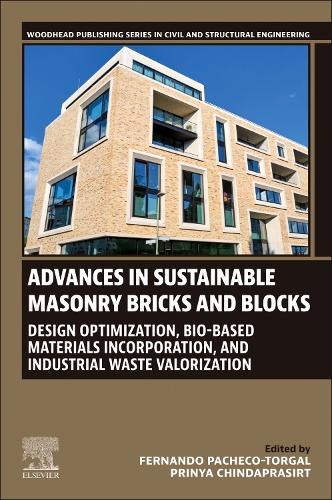
Advances in Sustainable Masonry Bricks and Blocks: Design Optimization, Bio-based Material Incorporation, and Industrial Waste Valorization is a comprehensive reference resource that addresses the latest advancements and innovations in this field. This book explores novel sustainable masonry innovations in design optimization, bio-based materials, and industrial waste valorization. Part I investigates novel structural strategies—topological interlocking blocks modeled and fabricated in UHPC with an MCDM framework for reusability, a PRISMA-guided review of hygrothermal performance in insulated composite masonry, and a self-sensing brick system enabling continuous structural health monitoring. Part II delves into bio-reinforcements: Juncus-fiber–stabilized compressed earth blocks, fiber-reinforced soil units, glycoprotein stabilizers inspired by termite mounds, lime-hemp and sugarcane bagasse insulation for CEB walls, waste-glass–infused clay bricks, and rice-husk-ash geopolymer blocks. Part III valorizes community and industrial by-products—paper, plastics, bagasse ash, marble and stone dust, coal ash—into fired and unfired masonry, and applies geopolymers to stabilize earth materials. Across experimental research, systematic reviews, full-scale testing, and case studies, it advances durable, high-performance bricks and blocks with reduced environmental impact.
Full Product Details
Author: Fernando Pacheco-Torgal (Principal Investigator, CTAC Research Centre, University of Minho, Guimaraes, Portugal) ,
Prinya Chindaprasirt (Director, Sustainable Infrastructure Research and Development Center (SIRDC), Khon Kaen University, Khon Kaen, Thailand)
Publisher: Elsevier - Health Sciences Division
Imprint: Woodhead Publishing
ISBN: 9780443403897
ISBN 10: 0443403899
Pages: 740
Publication Date: 01 December 2025
Audience:
Professional and scholarly
,
Professional & Vocational
Format: Paperback
Publisher's Status: Active
Availability: In Print

This item will be ordered in for you from one of our suppliers. Upon receipt, we will promptly dispatch it out to you. For in store availability, please contact us.
Author Information
Fernando Pacheco Torgal is a Principal Investigator at C-TAC, University of Minho. He holds the title of Counsellor (Top 0.5%) from the Portuguese Engineers Association and has been consistently recognized as a Scopus Highly Cited Scientist in the global rankings by Stanford University. With over 300 publications to his name, he has carried out in-depth peer reviews of more than one thousand scientific papers and assessed nearly one hundred research grant proposals across 15 countries. He serves on the editorial boards of nine international journals and has been involved in editorial decisions for several hundred manuscripts. In addition, he has edited 33 international books, many of which are available in the libraries of prestigious institutions such as Harvard, MIT, and Stanford. Professor Prinya Chindaprasirt is the Director of the Sustainable Infrastructure Research and Development Center (SIRDC), a research unit in Khon Kaen University. He is now also the head of Advanced Functional Materials research cluster of Khon Kaen University. He was appointed a full professor in 2007. In 2009 he was the first person in civil engineering who was appointed the highest rank professor in Thailand. He has set up the Thai Geopolymer Network in 2005 to promote the research and collaboration among Thai researchers in this field.